

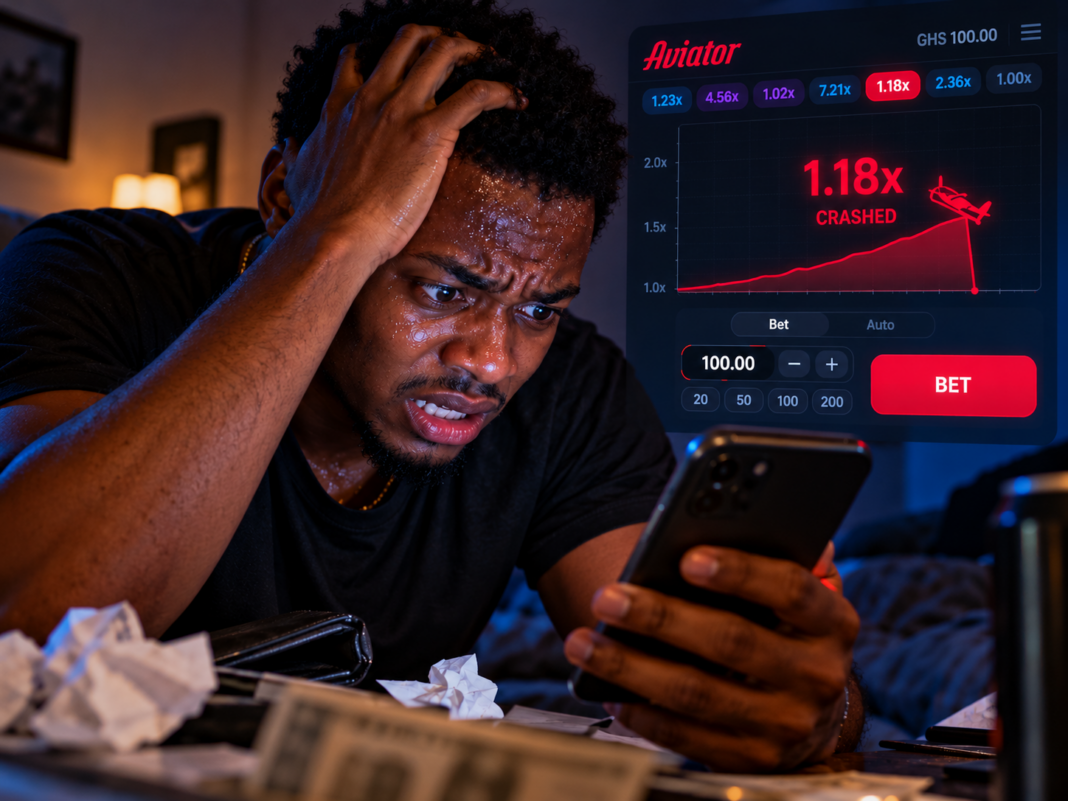
Are you dealing with a gambling addiction? If you are, this article is for you.
I’m not writing this as someone sitting somewhere judging you or pretending that quitting is as simple as saying, “Just stop gambling.”
I have been there. I know what it feels like to promise yourself that this is the last time, only to find yourself depositing again.
I know the shame. I know the debt. I know the feeling of winning money and somehow giving every pesewa back.
And I know that strange feeling when you desperately want to talk to somebody about what you are going through, but you are too embarrassed because you have already told everyone several times that you had stopped.
Maybe the first time you opened up, people understood.
Then you relapsed. You told them you were done again. Then you went back.
After a while, you become so ashamed that you stop talking about it altogether. You start thinking everyone will see you as stupid because you keep returning to something you know is destroying you.
And every time, you tell yourself the same thing:
“I just want to recover what I lost, then I’ll stop.”
But you don’t stop.
Your brain keeps reminding you about that one day when you deposited a very small amount and won big.
It tells you:
“It happened before. It can happen again.”
Sometimes you actually do win.
Maybe you deposit GH¢100 and suddenly you are sitting on GH¢2,000.
You tell yourself, “This time I won’t be greedy.”
Then somehow GH¢2,000 becomes GH¢1,500.
You try to recover the GH¢500.
Then it becomes GH¢1,000.
Then GH¢400.
And before you know it, everything is gone.
Now you need another deposit because you are convinced you can get it back.
That’s how the cycle continues.
Eventually, you start borrowing.
You take loans at ridiculous interest rates.
You make promises to people that you will pay them next week or next month.
Someone gives you money for something important and suddenly that voice starts again:
“Just try a small amount. Today could be your day.”
You tell yourself you’ll only use GH¢100.
Then another GH¢100.
Then another.
Before you realize what is happening, the money is gone.
Trust me.
I have been there.
I call it the “digital high.”
That feeling immediately after depositing.
Your attention becomes completely focused on the game. Your heart starts pumping. Nothing else seems important.
Then you start losing.
Once a significant part of your deposit disappears, panic replaces excitement.
Now you’re no longer trying to win.
You just want your original deposit back.
“If I can just get back to where I started, I’ll log out.”
But when you recover some of it, you continue.
And the cycle starts again.
You’ve probably told yourself:
“This thing is destroying my life.”
Maybe you’ve self-excluded from betting websites.
Maybe you’ve deleted the apps.
Maybe you’ve gone weeks or months without gambling.
Then one day you downloaded everything again.
You’re exhausted.
You’ve lost too much money.
And deep down, you don’t even necessarily want to become rich from gambling anymore.
You just want your old life back.
The life you had before you discovered casino games.
So let’s talk about how you start getting that life back.
First, Understand What You’re Fighting
There are different forms of gambling addiction.
Some people struggle mainly with sports betting.
Others struggle with virtual gambling — casinos, virtual sports, crash games and other games that operate continuously.
And some people struggle with both.
My biggest concern is with casino and crash-style games such as Aviator and similar products because of how quickly someone can repeatedly stake money.
There is always another round.
You don’t have to wait until Saturday for Manchester United to play.
You don’t even have to wait ten minutes.
Lose.
Stake again.
Lose.
Deposit.
Stake again.
That speed can make chasing losses incredibly destructive.
So here’s something I had to get into my own head:
YOU CANNOT BUILD YOUR RECOVERY AROUND THE HOPE OF ONE LAST BIG WIN.
Forget about recovering everything you’ve lost through gambling.
That money is gone.
I know that hurts.
But chasing yesterday’s losses can cost you tomorrow’s money too.
You may have heard stories about people losing businesses, cars, savings and property through gambling.
Maybe you’ve already lost things yourself.
Whatever you’ve lost, there comes a point where you have to stop digging.
You cannot change yesterday.
But you can stop today from becoming another yesterday you regret.
So let’s start.
STEP 1: Permanently Close Your Betting Accounts
Don’t just delete the apps.
Deleting an app is not enough.
When the urge comes, downloading an app again takes less than a minute.
You need to make gambling difficult.
Start by making a list of every betting or casino website where you have an account.
Include the obvious ones.
Include the ones you rarely use.
Include offshore or cryptocurrency gambling websites you’ve used.
Then go through them one by one.
Where permanent self-exclusion or account closure is available, use it.
If you cannot permanently close the account yourself, contact customer support.
Tell them clearly:
“I have a gambling problem. I want my account permanently closed and I do not want it reopened.”
Don’t ask for a temporary break if you already know what happens when the temporary restriction expires.
You’re not preparing to gamble responsibly later.
You’re trying to stop gambling.
If you have registered accounts using multiple phone numbers or email addresses, identify those accounts too.
I personally created a spreadsheet.
Website.
Phone number.
Account status.
Self-exclusion requested.
Account closed.
Then I worked through the list.
It sounds extreme until you understand something:
You are not building your recovery for the version of you that doesn’t want to gamble.
That person doesn’t need protection.
You’re building barriers for the version of you who wakes up one day desperate for money and suddenly believes Aviator is the solution.
That’s the person the barriers are for.
STEP 2: Use Ghana’s Gambling Self-Exclusion Options
Closing individual accounts is one layer.
You should also investigate the self-exclusion support available through Ghana’s gambling regulator and licensed operators.
Contact the Gaming Commission of Ghana through its official channels and ask specifically about the current process available to a person experiencing problem gambling who wants to restrict their access to gambling services.
Follow whatever current procedure they provide.
If forms are required, complete them.
If you need to provide the phone numbers associated with your gambling accounts, provide them through the appropriate official process.
And don’t just submit something and forget about it.
Follow up.
Your goal is simple:
Put as many barriers as possible between yourself and your next bet.
STEP 3: Close the “New SIM Card” Loophole
This was another problem I identified.
You may successfully block the numbers connected to your existing betting accounts.
For a while, everything is fine.
Then financial pressure comes.
Someone you owe starts calling.
A bill is due.
You suddenly remember gambling.
Your existing accounts are blocked, so your brain starts looking for another route.
“What if I register another number?”
This is why recovery cannot depend entirely on willpower.
You have to identify your own loopholes.
If access to identification documents makes it easy for you to register new accounts or numbers specifically to circumvent your self-exclusion, consider putting additional safeguards around those documents.
For example, a trusted relative could temporarily hold a document you rarely need, provided doing so does not interfere with your legitimate identification, banking, legal, travel or other essential needs.
The principle is more important than the specific method:
MAKE RELAPSE INCONVENIENT.
An urge can be incredibly powerful.
But urges don’t remain at maximum intensity forever.
If gambling requires ten deliberate steps instead of two taps on your phone, you give yourself time to reconsider what you’re doing.
STEP 4: Remove Gambling From Your Digital Environment
Blocking your existing accounts isn’t enough.
New gambling websites appear.
Advertisements appear.
Influencers post wins.
Telegram groups post screenshots.
Someone on TikTok turns GH¢50 into GH¢5,000.
And suddenly your brain forgets the thousands you lost and remembers the feeling of winning.
So clean your digital environment.
Leave gambling Telegram and WhatsApp groups.
Unfollow gambling creators.
Block pages constantly promoting betting.
When gambling content appears on Facebook, TikTok, Instagram or X, use the platform’s options to tell the algorithm you don’t want to see that content.
Don’t watch it “just for entertainment.”
Your brain doesn’t care that you told yourself you weren’t going to gamble.
A trigger is a trigger.
If possible, consider reducing your social media exposure during the early stages of recovery.
If your work doesn’t require a smartphone, even temporarily using a simpler phone may help.
If your work requires social media, then you need to become much more deliberate about what enters your feed.
Think of your brain as recovering.
You wouldn’t keep alcohol on the table in front of someone desperately trying to stop drinking and then tell them to “just have discipline.”
Don’t constantly expose yourself to gambling and expect willpower to do all the work.
STEP 5: Tell the People You Might Use to Gamble
CONFESSION TIME.
You’ve closed your accounts.
You’ve blocked your numbers.
You’ve removed gambling content.
Then your addicted brain discovers another loophole:
Other people’s accounts.
Maybe there’s a friend who doesn’t know you’re struggling with gambling.
Maybe there’s someone in your area who will deposit money anywhere you tell them.
Maybe it’s your driver.
Maybe it’s a relative.
You send them money.
They deposit.
They give you the account.
And you’re gambling again.
This is where secrecy becomes dangerous.
Tell them.
Tell anyone you know you might convince to deposit for you:
“I have a gambling problem. If I ever send you money and ask you to deposit it into a betting account for me, please return the money. Don’t do it, no matter what explanation I give you.”
You can go further.
Give them the contact of someone you deeply respect — your partner, parent, sibling, pastor, close friend or another trusted person.
Tell them:
“If I pressure you to help me gamble, call this person.”
It creates accountability.
Your addicted brain needs to know that the loophole is closed.
The more secrecy surrounding your gambling, the easier it becomes to relapse.
You don’t have to announce your addiction to the whole world.
But the people who can help you gamble should know they must never help you gamble.
And at least one or two people you genuinely trust should know what you’re going through.
STEP 6: Deal With the Debt — Without Gambling
This may be the hardest part.
You’ve finally stopped gambling.
But the consequences haven’t disappeared.
There are loans.
Friends you owe.
Bills.
Interest.
Maybe people are calling you.
Maybe someone trusted you with money and you lost it.
This is when your brain presents gambling as a solution again.
“Just one big win and all these problems disappear.”
Stop.
That’s the same thinking that helped create the problem.
YOU CANNOT BUILD A DEBT-RECOVERY PLAN AROUND MORE GAMBLING.
You may win today.
But if gambling has already become an addiction for you, the bigger danger is what happens after that win.
A win can convince your brain that gambling works.
Then you’re back.
Instead, write down every debt.
Not in your head.
Put it on paper or in a spreadsheet.
Write down who you owe, how much you owe, whether interest is accumulating, the payment deadline, the consequences of missing payment and what payment arrangement may be possible.
Then prioritize them.
If you owe friends or relatives, speak to them.
Don’t disappear.
Don’t promise impossible payment dates just because you’re embarrassed.
Explain what you can realistically pay and when.
If you have high-interest or otherwise urgent debts, consider getting qualified financial or legal advice about your options rather than making decisions out of panic.
If threats, harassment or intimidation become involved, document what is happening and seek appropriate legal advice or assistance from the relevant authorities.
Don’t assume that everything a creditor threatens to do is necessarily lawful.
And don’t make major decisions based solely on something you read online — including this article.
Get proper advice for your particular situation.
If you have family members you trust enough to tell, tell them.
Not necessarily because they should pay your debts.
They may not even have the money.
But addiction thrives in secrecy, and financial panic can make you do things you would never consider with a clear mind.
If nobody can financially rescue you, then you have to start rebuilding with what you earn.
It may be slow.
It may be painful.
But GH¢500 genuinely earned and used to reduce a debt is better than GH¢500 placed on Aviator hoping it becomes GH¢10,000.
One is recovery.
The other is another spin of the same wheel that brought you here.
The Money You Lost Is Gone — Accept It
This was one of the hardest things for me.
You keep calculating.
“If I hadn’t gambled that GH¢5,000…”
“If I had stopped when I was up GH¢20,000…”
“If I hadn’t deposited that loan…”
Stop calculating.
You cannot go backwards.
You can spend another three years mentally living inside the money you lost, or you can decide that your next GH¢100 belongs to your future.
The objective isn’t to recover your gambling losses.
THE OBJECTIVE IS TO RECOVER YOUR LIFE.
Those are two completely different things.
Forgive Yourself — But Take Responsibility
You made mistakes.
Take responsibility for them.
If people trusted you and you disappointed them, accept that.
If you borrowed money and lost it, you still owe the money.
If someone helps you, be grateful.
Nobody is obligated to rescue you from decisions you made.
But responsibility does not mean spending the rest of your life hating yourself.
You cannot change the bet you placed yesterday.
You can change whether you place one today.
Be careful who you open up to, especially when you’re desperate.
Desperation can make you vulnerable to scams, exploitative loans and people promising magical solutions.
There is no magical solution.
Recovery is usually boring.
Block accounts.
Avoid triggers.
Work.
Pay debts.
Talk to people.
Repeat.
One day without gambling becomes seven.
Seven becomes thirty.
Thirty becomes ninety.
And slowly, something changes.
The money you receive stops looking like gambling capital.
It becomes money again.
When Everything Feels Too Heavy
Sometimes the financial pressure becomes overwhelming.
Your phone keeps ringing.
People want their money.
You are ashamed.
You can’t sleep.
Your mind starts telling you that your life is finished.
It isn’t.
Take some space from unnecessary noise if you need to.
Speak to somebody you trust.
If you can afford professional therapy or addiction counselling, consider it.
And if things become so overwhelming that you start thinking about harming yourself or ending your life, please treat that as an emergency.
Tell someone immediately.
Stay around people you trust and seek immediate professional or emergency support.
No gambling debt is worth your life.
Money can be earned again.
Debt can be negotiated, repaid or otherwise dealt with.
Relationships can sometimes be repaired.
Businesses can be rebuilt.
Your life cannot be replaced.
If you believe in God, pray.
Even if you don’t know what to say.
Even if all you can say is:
“God, help me get through today.”
Then get through today.
Tomorrow, do it again.
If Someone You Love Is Addicted to Gambling
If you’re reading this because your husband, wife, brother, sister, friend or child is struggling with gambling, understand something:
Simply insulting them probably won’t fix it.
But neither should you continuously give them money without safeguards.
Be compassionate.
But be firm.
Don’t give them money to “win back” what they lost.
Don’t allow them to use your betting accounts.
Don’t help them hide gambling debts.
Help them create barriers.
Help them self-exclude.
Help them seek professional support.
Help them create a realistic debt repayment plan.
And understand that relapse can happen.
A relapse doesn’t mean recovery is impossible.
But it should be treated seriously.
Ask:
“How did you get around the barriers we created?”
Then close that loophole too.
My Final Message to You
If you are reading this at 2 a.m. after losing money on Aviator…
If you just lost your salary…
If you borrowed money and lost that too…
If you’ve promised yourself a hundred times that you would stop…
I know what your mind is telling you.
“One more deposit.”
Don’t.
Not tonight.
You don’t need to recover the money tonight.
You need to stop the bleeding.
Close the account.
Put the phone down.
Tell somebody.
Sleep.
Tomorrow, start fixing the damage.
It won’t happen overnight.
But every day you don’t gamble is a day you’re no longer making the hole deeper.
You’ve already lost enough.
Don’t let gambling take the rest of your life while you’re trying to recover the money it already took from you.
You deserve the opportunity to rebuild.
Start today.
A Note From the Author
This article is based partly on my personal experience with gambling addiction and the practical barriers that have helped me. It is not medical, psychological, financial or legal advice, and everyone’s situation is different.
Where possible, seek help from a qualified mental-health professional or addiction specialist, particularly if gambling is causing serious financial, emotional or relationship problems.
For regulatory questions, self-exclusion procedures or complaints involving licensed gambling operators in Ghana, contact the Gaming Commission of Ghana through its official channels and confirm the current procedures directly with them

